This issue began with the question of what constitutes sustainability within scholarly publishing. Looking back over the gestation of this special issue, we had to grapple with increasingly existential variants of this question.
What does sustainability look like when forest fires are approaching your home? When your university is facing cutbacks and programs are at risk of being closed down? When government agents are arresting people in their homes and on college campuses? When political extremism is rising? When so-called generative artificial intelligence is intensifying water and energy usage, while pumping out fever-dream irrealities, endless affirmations, and race-to-the-average information? When…? When…? When…?
How many crucial issues hang on this one concept, sustainability? What might it mean to reconsider this term in contemporary editing and publishing practice?
In an effort to rethink our work as academics, editors, and readers of published material, we came together to collaborate on this experimental issue hosted by The Goose and Imaginations. The Goose is the official, open-access publication of the Association for Literature, Environment and Culture in Canada (ALECC). Straddling academic and creative genres, The Goose publishes long-form academic articles alongside creative nonfiction, poetry, multimedia, and visual arts. Imaginations is an online, open-access journal of cross-cultural image studies. The journal publishes work that thinks about, with, and through images broadly construed. Together, members of our editorial teams have been thinking collaboratively about what we call sustainable publishing. In this context, sustainability names the terrain of both its resonance as a social and ecological concept and its capture by corporate and institutional branding campaigns that paint a green façade over otherwise categorically damaging operations—including the defunding of education in the service of fiscal “sustainability” and fantasies of “green” AI. This special co-published issue represents a snapshot of some of those conversations as well as a place for others to join the discussion about publishing practices for the 21st century.
Origins and Developments
As with all literature and academic publications, this issue has been the result of a long editorial process involving various forms of sharing, discussion, and knowledge co-production (a process that takes time—and to take time is in itself a move towards sustainability). The moment of inception for this project was a conversation between Brent and Rachel during the height of the COVID-19 pandemic where they discussed the idea of sustainability standards for academic publishing. Rachel secured an incubator grant from Memorial University’s now-shuttered Office of Public Engagement1 to explore this idea with colleagues serving on the editorial boards of three Canadian digital journals: The Goose, Engaged Scholar Journal, and Imaginations.
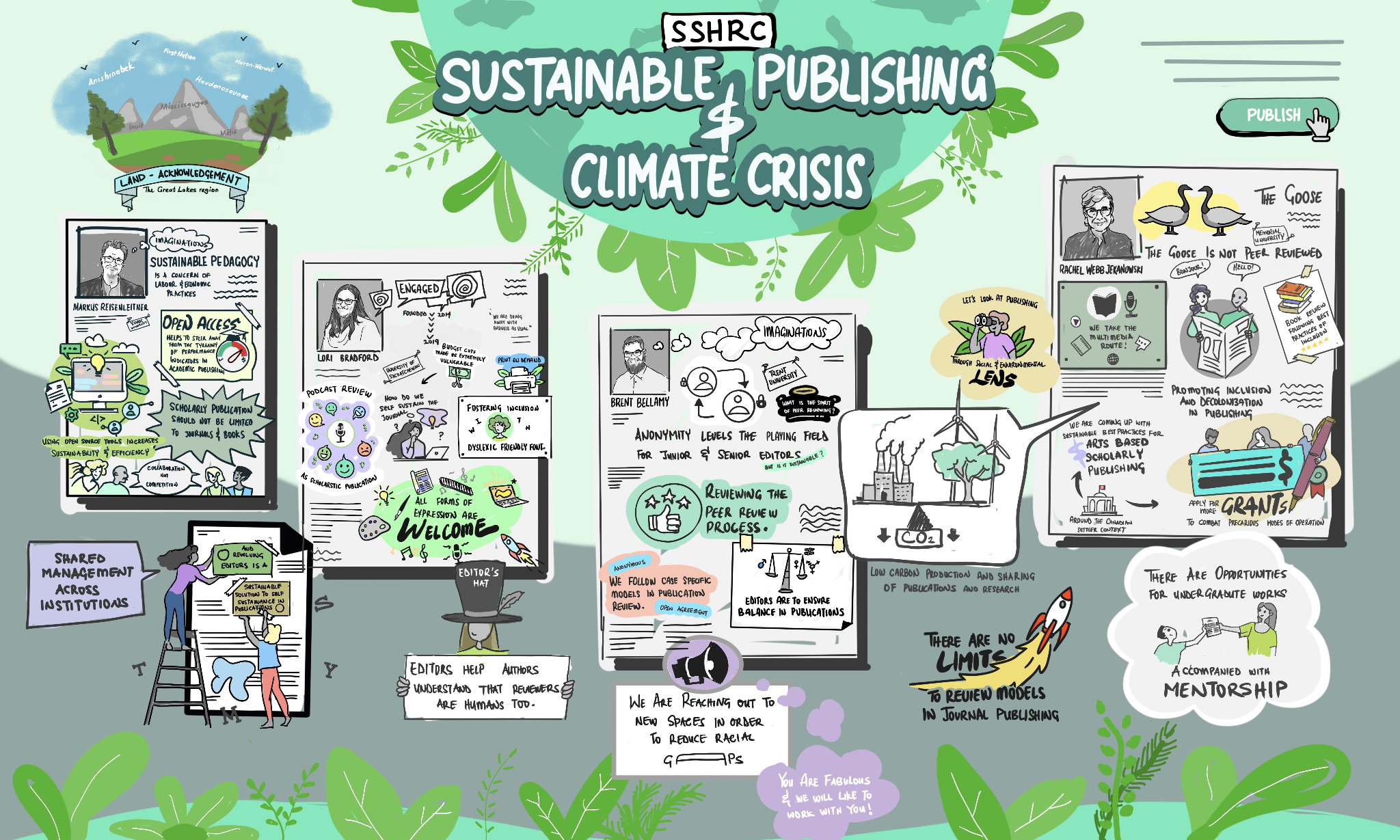
The project’s first iteration culminated in a 2023 roundtable discussion at a joint panel of the Canadian Communications Association (CCA) and the Canadian Comparative Literature Association (CCLA) at York University. Brent and Markus from Imaginations joined Rachel, then co-editor at The Goose, and Lori Bradford from Engaged Scholar Journal to host a roundtable on “Sustainable Publishing and the Climate Crisis,” exploring the modalities and possibilities of sustainable publishing in Canada. Demilade Oyatemi produced a visual aid as the roundtable took place, mapping each speaker’s interpretation of sustainability as a concept and methodological practice (see figure 1).
Our conversations during the roundtable formed the basis of what would become a refereed chapter in the edited collection Low-Carbon Research Methods: Making Equity and Epistemological Gains through Decarbonising Academic Work, forthcoming in 2026 from Goldsmiths Press. In it, we proposed our first articulation of sustainability as “a framework for staging practical and conceptual interventions into dominant practices of […] the editing, publishing, and circulation of research findings” (Bellamy, Bradford, Jekanowski, and Reisenleitner 176). Sustainable publishing therefore overlaps with scholarly interventions to decarbonize the academy, and to embed slowness and degrowth within increasingly fast-paced and precarious temporalities of academic work (Sterne 2011; Mountz et al. 2015; Martin and Nevins 2024). Put otherwise, sustainable publishing encompasses both labour justice and climate justice, and works in collaboration with other equity-informed movements towards imagining the university otherwise.
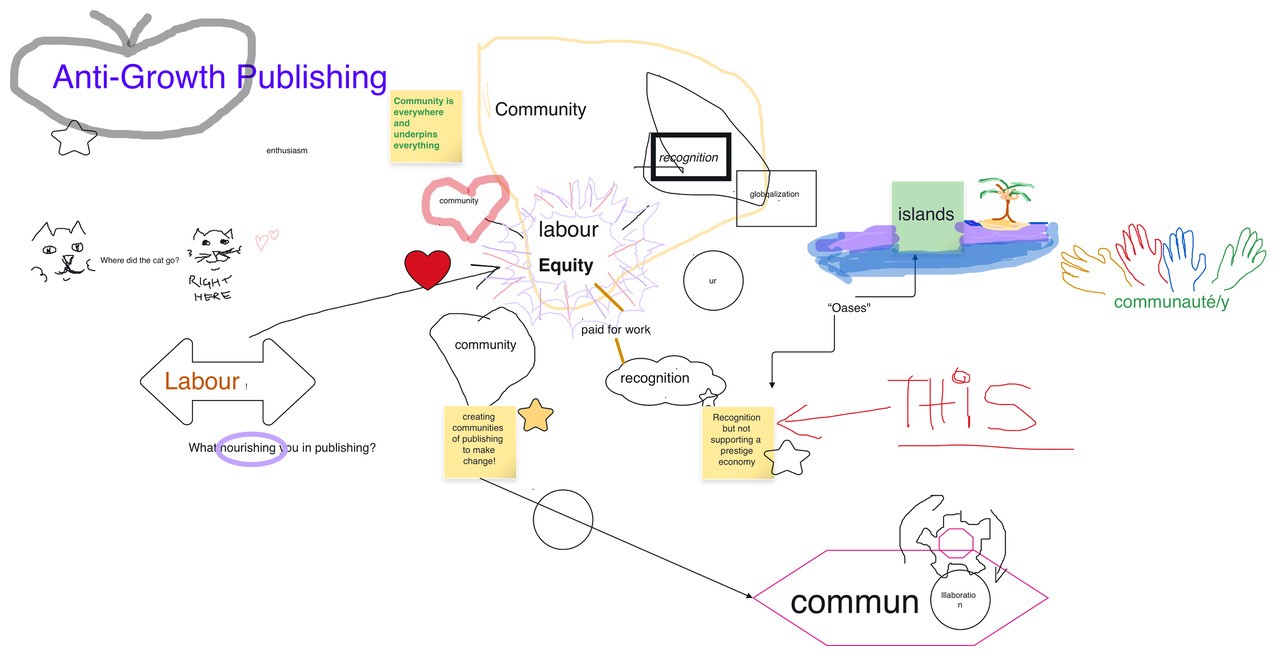
Following the roundtable and book chapter, the sustainable publishing team held an online, bilingual atelier in summer 2024. The atelier acted as an incubator for ideas, bringing together people from the scholarly publishing world and providing a space for collective feedback and experimentation. Prompting our participants to reflect on the concept of sustainable publishing and how their publications approach sustainability, we mapped out the present and speculative futures of publishing, and named our navigational poles: anti-growth, labour equity, nourishing, communauté/community, “paid for work,” recognition (see figure 2).
Meanwhile, Imaginations and The Goose planned for this special joint issue, inviting contributions in the form of articles, research creation pieces, and practitioners’ forum entries. As members of several journals, the sustainability practices we sought to create through these exchanges have taken shape in this multi-faceted dossier, published by both journals. The issue’s unique form—translated and interdisciplinary, compiled by representatives of two editorial teams—is intended to address the multiple challenges of our original question and imagine a pathway for implementing slower, engaged, and more reflective practices of publishing in tomorrow’s world.
This co-editorial experience was not without its difficulties in a climate of austerity, where academic timelines do not always coincide with the reality of writing practices. The slow rumination of these ideas reflected the multiple temporalities and challenges in which the issue’s authors and editors were working, including labour strikes, casualized teaching contracts, commitments to family and personal wellbeing, climate grief… the list continues.
We address such difficulties by working from where we are to extend a feminist, decolonial approach, much in the way Carrie Karsgaard’s “The Pedagogy of Manifesto Making: Countering the Oily Entanglements of Academic Publishing” reflects on Manifesto for Decarbonizing Scholarship and Research to emphasize decarbonization as a path to sustainability. Karsgaard calls on readers to sign on to the manifesto and distribute it widely. Along similar lines, Ela Przybyło poses a clarifying question in “Publishing Thoughts from the Bed Sorbonne”: how might publishing remold itself to fit crip writers, editors, and readers, rather than having people conform to normative expectations of publishing? Taking this question seriously promises radical change for everyone working in academic publishing.
In this introduction, we review the conversation on sustainability in publishing as it has been happening on our end. We discuss the theory and practice of sustainability as a multifaceted and oft misunderstood concept. Here, we also discuss some of the most recent technological developmentsin publishing, including Large Language Models (LLMs), and conclude by introducing the articles included as well as the practitioners’ forum.
On the Theme of Sustainability
Foundationally, we approach sustainability in terms of maintaining practices and processes though established routines without exhausting necessary inputs (resources, labour, etc.). At both journals we ask ourselves: what can we set in place to publish meaningful academic and creative work to diverse audiences? While it is certainly possible to sustain a project by using maximum effort, we are more interested in how we might undertake this work without depleting authors, editors, and readers, budgets and workflows, or air, earth, energy, and water.
This standpoint helps us frame sustainability in terms of current crises—environmental, political, societal—and the varied meanings of this concept. For instance, sustainability may refer to concerns of labour equity in academics’ day-to-day work, the carbon impact of content production (print and digital), and the development of publishing chains that are stable yet adaptable. Compellingly, in this issue, Ahmed Tahsin Shams points out that for most, sustainable publishing suggests “durability, optimization, or resilience.” Put differently, it signals a lastingness. His article, “Publishing with Tree-Media: Arbo-real Aesthetics, Pedagogical Ruptures,” proposes we start to incorporate a different temporality to the concept: “compostability,” or, “the capacity to decompose, co-adapt, and co-author with nonhuman rhythms.” The core of sustainable publishing for us is ecologically responsible, labour-wise, and socially-just editorial and publishing practices.
This response is how we have come to answer the above question: we can only publish meaningful academic, creative work when we attend to the health, energies, and equity of our teams, including authors, boards, distributors, editors, readers, and reviewers, and our systems, including environmental, political, and social health. To address this theme, our issue presents a multifaceted perspective, encompassing experimentation, research, creative writing, and methodology, and inviting collaboration across scholarly fields, workplaces, and languages. If sustainability is to be the framework for the future of publishing, in that it brings together multiple contemporary issues, it must be implemented collectively by experimenting with new models of knowledge production.
Articulating Theory and Practice: A Sustainable Perspective
To ensure that sustainability would not be addressed solely through the prism of theory, we sought to gather contributions that explore alternative publishing practices, experiment with collective writing, and develop novel models of scholarship, including zines, manifestos, and design thinking. Amy Brookes and Megen de Bruin-Molé’s research creation2 piece, “Notes on a Research Proposal,” exemplifies this vein. Their layered, annotated pages of a scanned epistolary exchange documents their revisions and critical reflections on a funding proposal to support their ongoing project, “Speculative Space,” which uses SF as an exploratory practice within galleries, libraries, archives, and museums. This piece serves as their response to the question of how “we sustain creative work in the face of burnout, institutional crisis, the end of funding, the mess of life?” while facing “institutional demands to validate [our work] using the metrics of academic research and funding frameworks.”
Articulating theory and practice in academic models of knowledge production in the humanities does not have a long tradition, which makes it all the more valuable and exploratory. Established through anthropological research (such as the work of Tim Ingold [1989, 2013] and Latour [2014]), digital humanities [Hayles 2005, Kirschenbaum 2016, Vitali-Rosati 2025], and new materialisms [Alaimo 2021, Barad 2007]), the reunification of practice and theory remains eternally complex, establishing a direct correspondence between discourses, notions, and concepts on one hand and practices, actions, and materialities on the other. Although they are not two separate worlds, institutional traditions reveal a division in which theorists do not make and are pressured by the imperative of ever-increasing scientific productivity (publish or perish), while practitioners are not in a position to formulate their experiential knowledge in the form of written research. This distance between occupations entails the risk of producing ever more disembodied knowledge, disconnected from the realities of its topics, or reinforcing ways of doing this for the sake of always having done them this way. Removing the time for critical reflection on scholarly practices and mechanisms (peer review, measurements of scholarly impact) discourages the search for creative solutions to real-world issues identified in academic outputs or new ways to undertake these tasks. Yet it is necessary to ensure the sustainability of our research, as it allows us to address questions such as durability and ecological impact in direct relation to physical, technical, and editorial conditions of production.
It is this history, these dialogues and practices of collaborative writing, connections and delays that this issue bears witness to, thus giving voice to multiple publishers of sustainable solutions for our knowledge and identities.
LLMs and Sustainable Publishing
How could we pass over generative artificial intelligence (GenAI) and large language models (LLMs) in silence? Certainly, this technology and its acceleration have implications for editorial work of all stripes. For our discussion here, in the introduction, we prefer the use of LLM to GenAI as a catch-all term because it is far less misleading and more precise. GenAI is a more general term, covering not just linguistic but also image-based generative software. More critically, it creates a need to define not only intelligence as a core concept, but also to augment that definition with a concept of the artificial (Agüera y Arcas). The idea of a LLM does not have the same conceptual risks. Instead of imagined boot-strapped thinking, these models process massive amounts of data from textual sources (e.g. articles, books, the internet, etc.) to leverage machine learning for a designated purpose.
It is no wonder then that LLMs present opportunities to transform the workload and workflow of editorial teams. For instance, with the capacity to template for email, arrange large datasets, review work in light of style guides, and take on other such tasks, LLMs might change the work of managing editors, directors, and copyeditors. Barring the risks of hallucinations when LLMs produce unreal information (Orgad), cheerleader behaviour when LLMs respond with pure encouragement to all ideas proposed (Suwito), the ouroboros-like self-referentiality these models threaten, other technological pitfalls, and their overall trash-like operations (Pasek) such tools promise increased productivity.
Our editorial mandate for this issue is to consider how to navigate the environmental, ethical, and legal impacts of LLMs for sustainable publishing practices. We want to look beyond first impressions of LLMs and consider the work that goes into developing, producing, and sustaining such tools. Remember that developing these tools took labour time (some paid, some unpaid) as these systems are trained by trial and error through many thousands of inputs. All so-called “labour saving technology” necessarily has more labour congealed within it. The same is true here: to develop these systems to where they are today, LLMs required enormous human and energy inputs—both of which required other sustaining systems in place to function (Dawson). There is already a significant amount of time and energy invested in these models before we even start to work with them. Moreover, those using LLMs need training as well. If LLMs are to be taken up as a tool in publishing, at any scale, they should be thoughtfully and ethically integrated, using step-by-step practices and sandboxing. As contributors to this issue note, “[c]elebrated gains in speed often mask declines in quality and accountability” (see Gordo et al., “Un/Sustainable Peer Review and Generative AI”).
Pivoting from the work internal to the journal, editorial teams also have to consider the work that comes across our desks. We have and will continue to be confronted by writing that could be LLM produced. The intensity and degree of this production may vary, as well. What amount of work with LLMs is acceptable in peer-reviewed work, especially when LLMs, by design, draw on the work of all of our peers without the protocols in place for citation? Moreover, it’s not just the volume of the work that’s in question. As editors, we might also ask how contributors use LLMs to produce their work. Developing best practices and ethical approaches to reviewing work in light of LLMs needs thought and care over time. This is exactly what Chelsea Humphries calls for in “Critical AI Literacy for Sustainable Scholarly Publishing” in the practitioners’ forum. These conversations are already starting to happen, which is a good first step. How can we make sure they continue to happen in an ethical, open, and sustainable manner?
On Transparency, Editorial Workflow, and Peer Review
As part of our commitment to reimagining sustainable editorial practices, this issue sought to experiment with the model of a “holistic” peer review. We wanted to find a means to nurture conversation and reinstate community within the editorial process and the final publication. Practically, this means that we shared the entire issue anonymously with at least two reviewers and we had several more pinch hitters as well (see Acknowledgements below). We encouraged our peer reviewers to approach the manuscript dossier as a sort of edited collection; to review the pieces individually as well as in relation to each other. What emerged was a thoughtful and engaged conversation about the strengths and weaknesses of the issue as a whole, areas of publishing that required more coverage (such as the perspectives of librarians), and the purposes of peer review itself. As Lisa Han observed in her review, the issue’s strengths include the “both practical and conceptual engagements with sustainable publishing, offering multiple pathways for thinking about the future of academic publishing” in relation to accessibility, AI, environmental impacts, academic accountability, and ethical relationships with communities, while providing “plenty of examples for scholars who aim to make their own publishing practices more sustainable.” Crystal Chokshi, another reviewer, reflected on the themes of fluidity and hope that she saw emerge throughout the assembled contributions. She noted in her response that amidst cascading social, political, and climate harms, “I rarely feel anymore what many of us might call “hope” […] Many days, it is hard to know how to move forward.” Nevertheless, the authors in this issue “[offer] ways to move forward in academia amidst the climate crisis and the many crises with which climate crisis is entangled” by proposing practices of “fluidity.” Citing Margot Mellet’s “Switch-off” as an example of this modality, Chokshi writes:
“This piece is about resisting an ‘always-on’ mode—whether ‘always on’ in a language or a hierarchy. If we make things fluid, what kind of sights/seeings and sustainabilities emerge? I think most pieces take up this very question.”
At the same time, both Han and Chokshi asked for greater engagement between individual pieces; in Han’s words, “it would be helpful for the individual pieces to reference each other when it makes sense to create a greater sense of cohesion across the issue as a whole.”
In light of this feedback, we shared the entire issue with our contributors following the holistic peer review–including the contributors’ manuscripts and reviewers’ reports. We consider this a version of open peer-review that still maintains anonymity for contributors and reviewers during the initial review and revision stages. This process provides more opportunity to know the issue as a whole, to cross-cite, and to incubate thinking on the subject matter. In addition to long-form academic articles, the issue also features a practitioners’ forum that discloses practical ideas for sustainable publishing from editors, librarians, researchers, and publishers. This, too, was included for contributors and reviewers to peruse. As part of realigning scholarly norms of peer review with our specific ethical and methodological goals, we also invited our peer reviewers to revise their reports for publication within the final issue. Aymeric Mansoux opted to go this route in his piece “Review,” which will be included in the translated version of this volume. While it may seem as though we asked a lot of our contributors and readers in terms of the amount of writing we shared, we also gave them the chance to engage at their discretion. Transparency means one may look, not that one is obligated to do so.
As an editorial team, we balanced and shared editorial work through our frequent check-in meetings. There was a more-or-less organic flow in responsibilities. As some team members became focused elsewhere, others kept the work moving forward for the issue. This has been true since the inception of the larger sustainable publishing project. Editors at The Goose managed the workflow of peer review and readers’ reports, while editors at Imaginations took on the copy editing and translating work. You can expect a second issue to follow with a full translation into French. We opted to embrace the spirit of slow academia, rather than rushing Gwladys Bertin and David Duhamel or delaying publication.
While our initial vision for this joint issue included a shared table of contents, articulated across our two journals like vertebrae in a spine, we struggled with the technological limitations of the journals’ respective software systems. Our solution sprang from practicality or, perhaps, exhaustion: we opted to host the issue at Imaginations due to the in-kind support from the University of Alberta Libraries, especially for such technical issues as DOIs and aggregator harvesting by Érudit. Such constraints of digital publishing were limiting, but also generative, compelling us as editors to critically engage with the software and digital infrastructures that platform knowledge-sharing today.
Overview of the Issue
This issue comprises two sections: scholarly articles and the practitioners’ forum. Contributors to the former adopt varying scholarly styles of writing and approaches to sustainability. Karsgaard et al. and Przybyło explore the manifesto as a call to action and academic form, while Pasek and Biørn-Hansen discuss the importance of zines as a practice of scholarly publishing in the form of an interview. Brookes and de Bruin-Molé’s research creation piece contributes to this examination of zines and related ephemera. Shams thinks, and publishes with, trees, exploring an elemental model of publishing grounded in the arboreal. Antoine Fauchié’s “Permapublishing : pour des modes d’édition pérennes” and “Un/Sustainable Peer Review and Generative AI: Ethical Gaps, Editorial Acceleration and the Whitewashing of Technological Solutionism” by Angel Gordo, Chris H. Gray, Ana Rodríguez, and Raúl Tabarés theorize the technologies and infrastructures of digital publishing, including the communities and practices they foster and the limits of GenAI.
The practitioners’ forum consists of shorter-form articles, authored by publishers, librarians, editors, and others who regularly work in the trenches of scholarly knowledge production and circulation. Our approach, here, is purposefully fragmented, overlapping, incomplete. This unevenness is a sign of cracking open, rather than a shortcoming; we challenge the impetus to cover everything (McKittrick 2021). Jessica M. DeWitt writes about her work as an editor of the Network in Canadian History and Environment (NiCHE)’s online blog. Likewise, Julia Jung, Manuela Rosso-Brugnach, and Christian Wiewelhove reflect on their use of research blogs at the FEELed Lab at UBC Okanagan. Beth Bouloukos and Fiona Polack both explore relationality within their experiences working at university presses; Bouloukos, in relational modes of publishing in Native and Indigenous Studies at Amherst College Press, and Polack, in relation to place-based scholarly publishing at Memorial University Press. Three of the issue’s editors—Margot Mellet, Brent Ryan Bellamy, and Rachel Webb Jekanowski—also contributed propositions to this forum, including proposals to “switch-off,” that “we are doing enough” and that editorial work is “a labour of love.” Finally, Amanda Wakaruk, Sonya Betz, and Chelsea Humphries offer necessary perspectives from academic librarians. Wakaruk and Betz (University of Alberta Library) structure their piece as a Q&A, exploring sustainability within library-based open publishing. Humphries (Memorial University - Grenfell Campus) articulates the need for critical AI literacy within universities as researchers, administrators, and students alike facing increasing pressure to take up these technologies.
As a whole, this issue sits with the daily pressures of undertaking scholarly work in environmental studies amidst the escalating disasters of climate collapse, anti-intellectualism, environmental racism, genocide, and the hollowing out of social infrastructures such as public healthcare and education. Pasek states in her interview with Biørn-Hansen that she’s “professionally freaked out by climate change.” We feel this in our bones. Nevertheless, life continues. We offer this assembly in the hopes that it might serve as a guide, perhaps even a balm, towards alternative ways of being in relation to the world as scholars, readers, and publishers. Towards building new scholarly communities and speculative roads towards sustainable knowledge systems for real-world change.
Acknowledgements
This issue has emerged from conversations with so many. Deep thanks to everyone who has thought with us and provided input along the way.
We are grateful to everyone who participated in the CCA/CCLA roundtable on “Sustainable Publishing and the Climate Crisis” in May 2023, including Crystal Chokshi, Susan Ingram, Margot Mellet, Susan O’Donnell, Shirley Roburn, Anne Pasek, Joshua Synenko, and Sophie Toupin. Thanks to Jeanette Hatherill at Coalition Publica for serving as a moderator at the bilingual Sustainable Publishing atelier in July 2024 and to those who participated in the atelier: Trish Audette-Longo, Suzanne Beth, Sonya Betz, Patrick Brodie, Crystal Chokshi, Jessica De Witt, Jordan B. Kinder, Chloë Marshall, Anne Pasek, Shirley Roburn, and Will Straw.
Financial support for the project came together from several sources. Thank you to Memorial University’s former Office of Public Engagement for providing our initial seed funding. Demilade Otayemi was hired with support from Lori Bradford’s Tier II Canada Research Chair in Incorporating Social and Cultural Sciences into Engineering Design (University of Saskatchewan) to create the graphic recording of the CCA/CCLA panel. Imaginations holds an Aid to Scholarly Journals grant from the Social Sciences and the Humanities Research Council.
Thank you to the members of the Imaginations team who translated and copyedited the issue, including Gwladys Bertin, Lee Campbell, David Duhamel, and Ben Robinson. Big thanks as well to Rina Garcia Chua and Jessica McDonald, former co-editors at The Goose, and Esther Oyeneyin, former editorial assistant, who provided support for early stages of this project.
Finally, thank you to our superb peer reviewers. Crystal Chokshi and Lisa Han read through the majority of the issue providing thoughtful general feedback and inspired direction for our contributors. Amanda Paxton and Emily Roehl came in at a later stage to review the final additions to the issue. Aymeric Mansoux has provided a rare level of precision and benevolence in bilingual supervision, showing new meanings to the sustainability of scholarly practices. The work of peer review so often goes unrecognized in the service of academic integrity. We want to be part of a movement to transform what integrity means in publishing. Rather than using anonymity to protect against the risk of bad actors in academic reviewing, we champion transparency and trust: from the start, the reviewers were informed that we could reveal their identity along with the authors when the issue went to press. Reviewers, readers, and authors all benefit from entering into conversation with each other, and we hope to continue to expand and experiment with peer review at Imaginations and The Goose.
Works Cited
Alaimo, Stacy. “Sustainable This, Sustainable That: New Materialisms, Posthumanism, and Unknown Futures.” PMLA/Publications of the Modern Language Association of America, vol. 127, no. 3, 2012, pp. 558-564, doi.org/10.1632/pmla.2012.127.3.558.
Agüera y Arcas, Blaise. What Is Intelligence? Lessons from AI About Evolution, Computing, and Minds. MIT Press, 2025.
Barad, Karen Michelle. Meeting the Universe Halfway: Quantum Physics and the Entanglement of Matter and Meaning. Duke University Press, 2007.
Bellamy, Brent Ryan, Lori Bradford, Rachel Webb Jekanowski, and Markus Reisenleitner. “Sustainable Publishing.” Low-Carbon Research Methods: Making Equity and Epistemological Gains through Decarbonising Academic Work, edited by Anne Pasek and the Low-Carbon Research Methods Group, Goldsmiths Press, forthcoming 2026, pp. 175-195.
Callanan, Andreae. “Doing the Heart Work: My Time with Memorial’s Office of Public Engagement.” The Independent, 20 Aug. 2025, theindependent.ca/commentary/columns/state-of-the-university/doing-the-heart-work-my-time-with-memorials-office-of-public-engagement/.
Dawson, Ashley. “The Costs of the Cloud.” The New York Review of Books. 27 September 2025, nybooks.com/online/2025/09/27/the-costs-of-the-cloud/.
Hayles, N. Katherine. My Mother Was a Computer: Digital Subjects and Literary Texts. University of Chicago Press, 2005.
Ingold, Tim. “Tools, Minds and Machines: An Excursion in the Philosophy of Technology.” Techniques & Culture. Revue Semestrielle d’anthropologie Des Techniques, no. 12, June 1989, n.p., doi.org/10.4000/tc.805.
Ingold, Tim. Making: Anthropology, Archaeology, Art and Architecture. Routledge, 2013.
Kirschenbaum, Matthew G. Track Changes: A Literary History of Word Processing. Harvard University Press, 2016.
Latour, Bruno. “Agency at the Time of the Anthropocene.” New Literary History vol. 45, no. 1, 2014, pp. 1-18.
Loveless, Natalie. How to Make Art at the End of the World: A Manifesto for Research-Creation. Duke University Press, 2019.
Martin, Patricia M, and Joseph Nevins. “Energizing Slow Scholarship: A Political Ecology Approach to a More Just Academy and Beyond.” ACME: An International Journal for Critical Geographies, vol. 23, no. 4, 2024, pp. 302-309, doi.org/10.14288/acme.v23i4.2471.
McKittrick, Katherine. Dear Science and Other Stories. Duke University Press, 2021.
Mergler, Agata, and Joshua Synenko, eds. “A Research-Creation Episteme? Practices, Interventions, Dissensus.” Imaginations: Journal of Cross-Cultural Image Studies, vol. 15, no. 3, 2024.
Mountz, Alison, Anne Bonds, Becky Mansfield, et al. “For Slow Scholarship: A Feminist Politics of Resistance through Collective Action in the Neoliberal University.” ACME: An International E-Journal for Critical Geographies, vol. 14, no. 4, 2015, pp. 1235-59, doi.org/10.14288/acme.v14i4.1058.
Orgad, Hadas, Michael Toker, Zorik Gekhman, Roi Reichart, Idan Szpektor, Hadas Kotek, and Yonatan Belinkov. “LLMs Know More Than They Show: On the Intrinsic Representation of LLM Hallucinations.” arXivLabs, 18 May 2025, doi.org/10.48550/arXiv.2410.02707.
Pasek, Anne. “AI is Trash.” Journal of Environmental Media, vol. 6, no. 1, April 2025, pp. 93-98, doi.org/10.1386/jem_00138_1.
Sterne, Jonathan. “The Politics of Academic Labor in Communication Studies: A Re-Introduction.” International Journal of Communication, Academic Labor, vol. 5, 2011, pp. 1853-1872.
Suwito, Ray. “AI Cheerleaders: Why Your Assistant Says ‘Great Idea!’ to Terrible Ideas.” dev.to, 15 August 2025, dev.to/ryo_suwito/ai-cheerleaders-why-your-assistant-says-great-idea-to-terrible-ideas-1jne.
Vitali-Rosati, Marcello. C’est la matière qui pense. « De code et de plomb ». Presses universitaires de Rouen et du Havre, 2025.
Image Notes
Figure 1. Demilade Oyatemi. “Sustainable Publishing & Climate Crisis,” Joint CCA/CCLA panel on Sustainable Publishing, 31 May 2023, York University.
Figure 2. Workshops notes compiled on a digital whiteboard during the Sustainable Publishing Atelier, 23 July, 2024.
Notes
Memorial’s Office of Public Engagement (OPE) was abruptly closed in July 2025, a casualty of institutional cost-cutting. This loss is strongly felt across the province of Newfoundland and Labrador, as well as by the editors of this issue. As austerity-focused cuts continue to whittle away arts and service-oriented components of Canadian academia, we are left with the question raised by the OPE’s first and last symposium in May 2025: what do universities owe the public? For a mediation on the impacts of austerity (so often invoked in the name of fiscal “sustainability”), see Callanan 2025.↩︎
For further discussion of creative practices in knowledge communities, particularly in Canada, see Loveless 2019 and vol. 15, no. 3 of Imaginations (2024), edited by Agata Mergler and Joshua Synenko.↩︎