This conversation was recorded on October 4, 2024. It has been edited for clarity and to add relevant citations.
Anne Pasek: Thank you so much for having this conversation with me. I’m really excited to hear more about your experiences with zine-based publishing and alternative conference tracks, as well as all the ways this work connects with our mutual interests in sustainable technology and energy transitions in academia.
Aksel Biørn-Hansen: I think there are a lot of interesting things to unpack. Let’s start with DIY Methods.1 It was one of the first initiatives that I saw that really did this on a big scale, inviting people into a different and new kind of process. Do you want to tell a bit about what the DIY Methods Conference is, and how it came to be?
Pasek: Sure. DIY Methods is a conference about experimental research methods, conducted by zine.2 It is a provocation for scholars to consider alternative ways of doing research exchange, both stylistically and environmentally. We’ve run it through my lab for the past three years, and we just published 2024’s proceedings this week.
Participating in DIY Methods looks very different from your typical conference. No one gets on a plane or sits in front of a screen. Instead, we jury, print, and collate zines, which we then send in the mail to participants.
This shift is important to me because, in my wider political and scholarly life, I’m sort of “professionally freaked out about climate change.” Because of this, I’m quite worried about academic aeromobility—our tendency to fly a lot is part of our broader professional culture and is a real barrier to building a more climate-conscious university (Tseng et al.; Katz-Rosene and Pasek). I want to see a global academy that flies less, but it’s clear that there are better and worse ways to do this. For instance, during the pandemic we were all suddenly, non-consensually, grounded. This resulted in a lot of Zoom-based conferences that didn’t really think too terribly much about the form of things, right? There was a crisis pivot moment where we wanted to keep the continuity of academic life going, even if those forms weren’t really bringing a lot of joy. I’m sure we all remember a lot of bad user interfaces, a lot of sitting stuck at your desk for multiple hours a day, and sort of pixelating your eyes in unlovely virtual rooms.
As a result, since travel restrictions have been lifted, there’s been a sudden return to normal—even an intensification of aeromobility—which makes a certain kind of social sense. People are a little bit traumatized and want to forget (Thierry) rather than learn from the pandemic. But unfortunately, the race back to in-person gatherings has also meant an uncritical acceleration of air travel and thus ever more increasing carbon emissions. Zoom conferences today (though they continue to provide important accessibility benefits) are still more of a supplement than a replacement to in-person gatherings.
So by having a zine-based conference, we were hoping to find a third option, a wedge between the dichotomy of online versus in-person conferences, and to also really try to practice our environmental values through a more deliberate politics of pleasure. By moving to print, and by letting people be creative in how they approach the visual and textual qualities of their ideas, we wanted to spark new possibilities and a critical re-evaluation of what the form academic exchange should be. Hopefully, too, our participants would find ways of presenting versions of their academic selves that are a little less buttoned-up and overdetermined by the conference room or PowerPoint as the dominant media and milieu in which “good academic work” happens.
The results have been pretty positive. For one, people genuinely like getting a kilogram of zines in the mail. Participation is free. It emits way less carbon. It also doesn’t come into tension with the ongoing care work obligations or administrative and financial burdens that we know produce inequities with the demographics in-person conference participation (Skiles et al.). Three years in, we’re continuing to see that idea be of interest to people, and be the kind of impetus for publishing some really interesting and provocative zines.
So that’s DIY Methods. We started in 2022, wrote a white paper on how we did it (Rayner and Pasek), and have been really delighted to see a couple of different groups take that idea and run with it in their own directions and add to the collective notion of what a zine-based conference could look like and do.
One of those projects was your own. I was really very excited when I saw the CFP for ICT4S (Information and Communication Technology for Sustainability) this year! I think you’ve maybe gone the furthest of all the folks that I know in trying to run a parallel zine-track within an already existing conference. Could you tell me a little bit more about how that idea started, and what it was like to pull that off?
Biørn-Hansen: Yeah, I think it has multiple starting points. But I think one was that we had a big, three-year long research project on academic flying and one of these parts of the projects we ended up submitting to DIY Methods (Biørn-Hansen et al.). We found that experience really invigorating in expressing ideas that were maybe very hard to do with less conventional data. We didn’t have enough grounding, you know, to submit it to a journal, but we could share our findings with that community. And so that sort of simmered a bit.
And then we, my research group, the Sustainable Futures Lab in Stockholm, we are quite active in the ICT4S Community and the ICT4S Conference. In 2023 it was hosted in Rennes, in France. They promoted flying (we took the train there). But this conference has a tradition of being a bit conservative, or like techno-optimist and tech-solutionist. And so at the conference, the papers and the things and the topics discussed were mostly about efficiency measures, maybe working with incremental changes and better computer systems. But then, we sort of felt this… There was a lot of tensions in the rooms and in the conversations during coffee breaks, and there was one specific paper track that had a lot of discussion. It was a session on measuring the energy consumption of, I think, eco-efficient data centers. During the Q&A, a more or less heated argument emerged where critics asked why this direction was important compared to more critical and transformative topics such as a focus on reducing the complexity of computer systems or degrowth computing (e.g. Espãna et al.). I think it was a clash between different worldviews that happened, between ideas of technological solutionism on the one hand and fears of how computer systems are accelerating the climate crises (Nardi et al.). Throughout the conference you could feel this simmering, but these tensions were never recognised publicly and not given space to be properly addressed during the conference.
After the conference, we travelled back home. And I thought this was peculiar. And like, what? Why was there so much tension? And then, my research group decided to run next year’s ICT4S conference. We had lunch one day and we sat there in the restaurant thinking, how could we sort of play into those tensions? How could we unpack what was happening and give space to all those unsaid ideas that were not part of the formal program in France in 2023? Elina Eriksson said, “Let’s make a zine!” And so we ran with the idea of trying to have an alternative, maybe not companion, but an alternative proceeding that went alongside the official program as a way to show and act against some of the mainstream narratives at this conference.
Pasek: It’s kind of a “Shadow Conference.”
Biørn-Hansen: Yes, I think one could see it like this. Oliver Bates, who was my co-editor and conspirator, and I—we struggled a bit with sort of appealing to this “Shadow Conference” idea without appropriating the whole concept of zine making just to fit into this context. So we worked a lot with finding the right language, finding the right ways of explaining what this was without it being seen as a formalization of these counterculture or radical ideas.
Yeah. And so we applied the DIY Methods template: soliciting abstracts, inviting people to create, and then published a zine compilation called Liminal Excavations (Biørn-Hansen et al.). We didn’t do separate zines, but a single book with many zines together. A zine compilation? I don’t know what to call it.
Pasek: Proceedings? Does that language work?
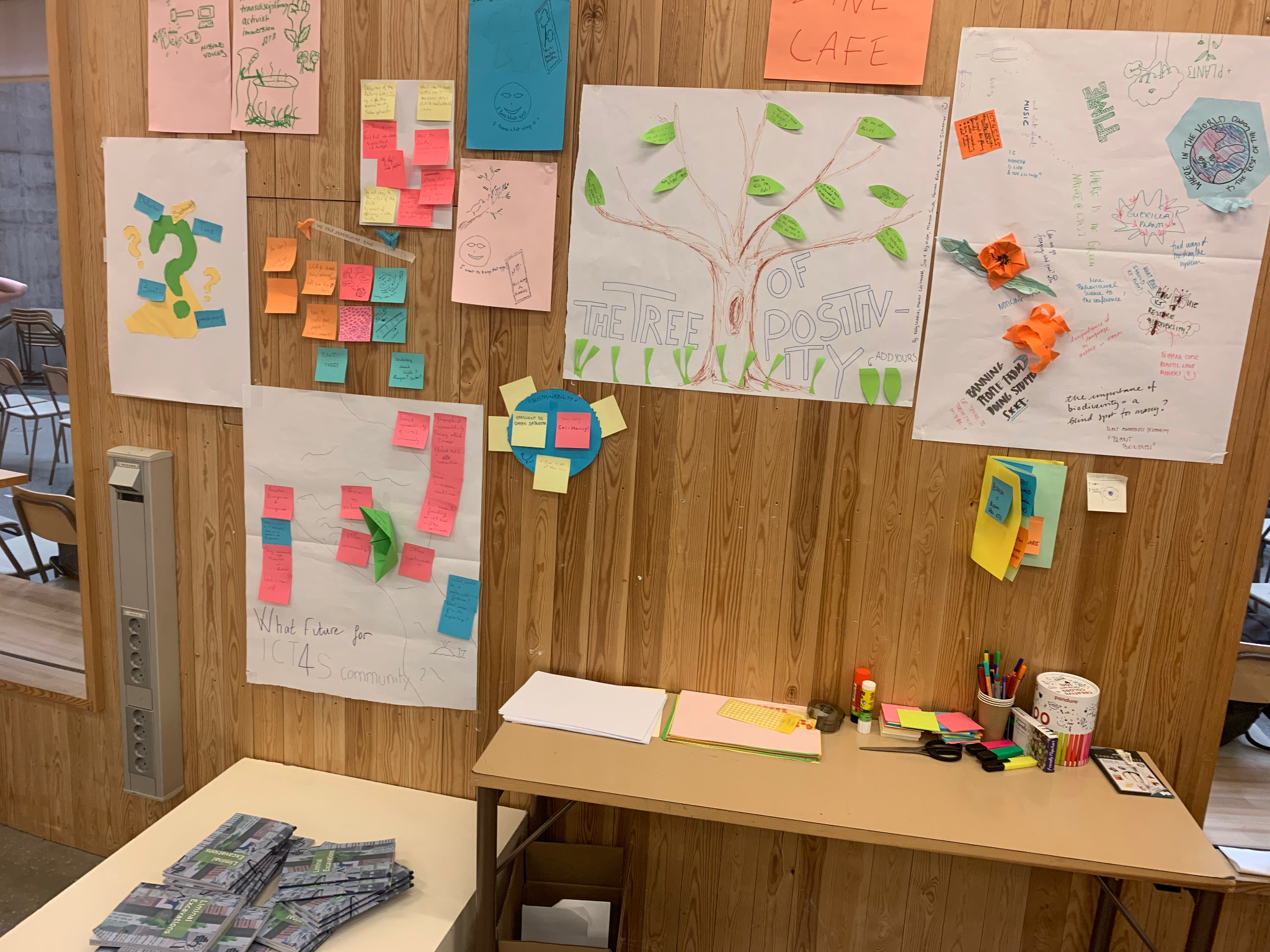
Biørn-Hansen: Yeah, we can call it that. We printed like 150 copies and we put them on tables without saying anything. We hosted a small session where we talked about why we did this, and then invited people to have a zine cafe where they also could sort of react back to the zine. And they started making things and having discussions at tables. And we also made a zine station (see figure 1) during the whole conference, where people could sort of express their frustrations or their ideas or questions—to give space to all of those things that we saw from the previous years. Someone made a “tree of positivity” where people could share positive experiences from attending the conference, while others critically reflected on the lack of research and thinking about the more-than-human in the ICT4S community. So that’s sort of the long format of the story, I think.
Pasek: The concern about having the “right emotions” there is so fascinating! So how officially sanctioned was the zine track?
Biørn-Hansen: Yeah. So Elina Eriksson and Daniel Pargman were the general chairs of the conference. They endorsed this, but not publicly. But they were fully on board, and also gave us a small budget to print, and also post this on the conference pages. That was a way for us, I guess, to reach out to the general ICT4S Community. I don’t think everyone understood what it was and so we also shared it in many other arenas. And then also Elina and Daniel, as the general chairs, gave us a spot in the program to do something. And that’s where we were a bit hesitant because we didn’t even think that we would have a program point. We were first exploring the idea of printing the whole zine page by page on A1 paper and putting it on the walls and just, you know, be a bit provocative or not saying anything. I think they gave us the space to do something, but they didn’t demand a certain format. It could be very different in a different setting, right? And I don’t think I would have appreciated it being very formalized. So that’s why we did this sort of small trio conversation and zine cafe format to engage people rather than have them sit and listen to presentations.
Pasek: Yeah, it’s so interesting. I am drawn towards print because of this stealthy politics of pleasure and conviviality, whereas for you it seems like it was a way to make a really important intervention and to share some dissensus that was otherwise difficult to accommodate in the typical format of the conference. Why do you think that print was so productive for getting those ideas out?
Biørn-Hansen: Hmm. What do I think? I think print is important, but I don’t think the printing is the only thing that made it different.
Printing it out—it is tangible. It’s something you can hold in your hand. You can share it like in DIY Methods. You send it by post, right? But here we had a space. We could go and give zines to people, and they could share them with others. We decided actively to print on a kind of paper that you can draw on so people could scribble and doodle. Also, it gave, I guess, the authors, the contributors, this sort of end object or artifact they could contribute to… I don’t want to say product—but artifact. Yeah, I don’t know—why do you think print is important?
Pasek: I come out of a more of a media studies background than an HCI (Human-Computer Interaction) or critical ICT (Information and Communications Technology) perspective. And you know, there we are very fond of stories about the power of print. There’s the idea from Voltaire that the most dangerous book is a very small and cheap one, right (Cronk)? One that can communicate its ideas stylishly to a mass audience, but with some economy, and can slip into one’s pocket. This kind of print culture can set an agenda in a way that’s quite hard to do if you’re otherwise beholden to the forms of attention and the performance of rigour that comes from traditional academic publishing.
And also, I think conferences are so interesting socially. They are spaces where our capacities to communicate interpersonally are often driven to the point of exhaustion. There’s always that moment where we’re just going to go hide in a corner to recharge, right? And I think having just a lot of print materials floating around those spaces lets ideas land wherever people are at, asynchronously and evolving. It can be fodder for gossip that’s going to spread around the conference. And so if you’re hoping to create an intervention in a scholarly community it seems like a great way to do so.
Biørn-Hansen: Yeah, I really think that is what happened. We wrote this in the call for papers, and also we encouraged the authors to also include something that made the reader able to engage: it could be like a blank page to write something on, or a small activity, because in the conference it would be physically printed. You can bring it around with you. In the end, one contribution in the zine asks the reader to draw plants they saw around them (Cerna & Christophersen), while another invites the reader to start cutting and recreate the pages to explore questions about the Internet of Things and repair (Fixing the Future Collective). I think the tangible affords so much more than digital materials when you have these social meeting points. So that is why—that’s the power of it. But I mean the zine format is also—it’s enough. Inexpensive printing and sharing is kind of the essence of it all.
Pasek: Yeah, the circulation of these objects is also impossible to predict at the beginning, and that’s part of the charm. With DIY Methods, we know that a lot of the stuff that we publish ends up getting used in classrooms because students also appreciate being communicated with more of a human face and with more brevity than the traditional academic article. In particular, there’s this one participatory action research zine by Megan Heise that I send all my students to whenever they need a PAR 101. Our surplus zines are also used as gifts for visiting scholars passing through my lab, or just for people that I know who care about a topic that we’ve published on.
We’re really interested in the kind of “gift economy of research” that these exchanges help us understand as such (Rayner et al.). Like, we produce these papers that, as you well know, contain countless hours of work—an amount of work that, if we were to try and quantify from an hourly wage perspective, would make us all look like fools. So, it’s nice to have a way of addressing the reader, saying, “This is a gift we’re giving you. This is an object that we have put value and care into, and even though we don’t know who you are, we want you to have it.” I’m interested in the work that affective dimension might be doing within the reading/research exchange.3
Biørn-Hansen: Yeah, I think that’s important. Despite all of the good things with these experiments, there’s a lot of resistance from people saying, “Not like this. This is so strange or different from what I usually do,” or “Oh no, I don’t know how to draw!” or yeah, just people can’t imagine doing something that is so visceral and in a different media or form than the written word. And, okay, zines can also be only words. But I had a feeling that people don’t really know or understand, or are a bit resistant to, this sort of format, because it’s so different.
Pasek: I want to ask you about that because I think there are sort of two concerns or barriers (and probably different strategies!) for how to address this. As you mentioned, 1) academics are not often trained in the design skills that a person would need to make a very slick looking zine. And of course, we know that the history of zines is one that’s full of very amateur forms of making that often prove that one doesn’t need a graphic design degree to make something good, or that doing something without design training can often be part of making the point you want to make, or making something truly original. But how to bring people into that zone of discomfort, and how to encourage people to present themselves in front of their peers in a way that isn’t perfect? I’m curious about that.
And 2) I’m also curious about the need for academic legitimacy. It’s understandable that, if you’re going to put time into something, you want to ensure that it will be recognized in forms of review that you’re subsequently going to be subjected to, whether that’s the job market or a grant or eccentric performance indicators at your university.4
How have you tried to tackle either of those problems?
Biørn-Hansen: I think this is really hard. Just to bring people in—both those who feel like they have the capacities to do and make really nice things, and people that really want to share something, but don’t feel the courage to just make something. In the call we tried to write this in words. But that’s words. I don’t think people can tell someone, “Yes, you can just put together some scans of words, and, you know, make something.” You don’t need to pull up InDesign or Illustrator and start making something very advanced. So, we had contributors who sent in pictures. There was everything from the very simple, like, “I’m just gonna see if I can try to put together some pages about this concept,” or “We are going to unpack this research paper in six pages, and it’s going to be full of material.” But luckily we had these sort of “zine circles.” So when we had sent out the notification to people whose proposals were accepted, we invited them also to a conversation so that we could burst some bubbles about what zines are or should be. This helped some of the participants feel that they could make something that was not, you know, picture perfect. And there was one of them who really said, “I don’t know what to do. I will see if I can try to make it happen!” In the final zine, we have everything from very sophisticated collages with different visual depths and colours and hand-drawn illustrations, to black and white text with a few pictures added in. I think, meeting the participants and talking about those fears or uncertainties really helps break some of those barriers to engage. But I think it’s also challenging, because, you know, it can become too advanced or too slick or too nice.
Pasek: Yeah.
Biørn-Hansen: Well, at least that is what Oliver Bates thought, because he’s more like, “It shouldn’t be all perfect! It shouldn’t all be sleek and nice! Maybe even it should look a bit rough.” And talking together about it, I think we did that a lot about the sort of aesthetics and language that we wanted to bring into this. But I don’t—we didn’t put any restraints on, that “It shouldn’t look like this.” But I didn’t want…
Pasek: …want to be the aesthetic police?
Biørn-Hansen: Yes. But I know with DIY Methods, when I got that box it was everything in between so and I don’t know. Do you want to reflect back a bit on that and how you communicated, or tried to mediate, those sorts of differences?
Pasek: Yeah. So I’ll say, first of all, we also did the zine making circle thing recently with accepted authors working on their zines, and found it really helpful. It’s useful for people to have a community of practice when they’re doing something new. It has me sentimentally thinking: wouldn’t it be great if all conferences had a little Zoom meetup before the event, where, even if you’re just writing papers, you could sit and write your papers together? There’s a way in which that kind of primes you to maybe be a little bit more invested in the success of everyone rather than seeing them as rivals for the shared and finite attention available at the hotel during the conference.
But yeah, we have seen a really diverse set of formal aesthetic skills in DIY Methods. And I think that’s ultimately good for ensuring that present and future contributors feel like they can participate, regardless of skill. There are zine authors who teach in design schools and contribute very beautiful objects. I’m thinking, in particular, of one about textiles, technology, and feminism that came out in last year’s proceedings and involved computer-stitched covers that held together a series of very sleek, beautiful booklets (Psarra and Desjardins). There was another, printed on large format newsprint, that could be folded and cut to make a pop-up map of Providence’s historic Chinatown—a very analog (and thus senior-friendly) kind of VR experience (Yoo Warren and Tarrersfield)! You know, these are really pleasurable objects to have and hold. But there’s also plenty of work that’s made from collage and photocopied or just done up in Microsoft Word, and that’s totally fine. It’s great for us, because it means that we can support people with a stipend if they want to print something complicated on their end that involves specialized equipment (we don’t have computer-assisted sewing machines!). But it also means people can just send us a PDF and we’ll print it, either at our campus print shop or with our little risograph printer (which is delightful and cheap!).
Biørn-Hansen: There are a lot of considerations to make it happen—to make the zine circle, to make the timeline work, to be able to put everything together. What were the most challenging and the most exciting parts of bringing the zine proceedings together from start to finish?
Pasek: I think the most challenging part is being an actual publisher. You’re responsible for the execution of people’s visions. So little in academia prepares you for that! And so, to make your life easier and to prevent heartbreak, it’s really important to clearly communicate where the boundaries of possibility are so you know what we can and can’t accommodate and have a fair estimation of what the final product might look like in our hands. But you know, if this is your first attempt at layout, you might colour outside those lines, and we’ll need to work with people to do some retroactive fixes to their design to make sure that it’s printable in a way that will be a good outcome, even if it isn’t the outcome they initially imagined. As academics, we’re normally troubleshooting citations and questions like, how does the flow of an argument work? But now we’re also thinking in the register of form and how to support the people we’re publishing by making their argument through both images and text and different kinds of print materials (this year we had entries made of felt (Schmidt) and the disassembled parts of a shortwave radio receiver (Wintermeier)). This isn’t a skill that I think everyone comes by naturally. My first degree was in Fine Art so it often feels, in a way that’s familiar and fun, like doing a studio critique. But it does have its challenges, and we don’t always get it right.
And then, in terms of just the labour and effort of it, we’ve been able to finance DIY Methods through a Canada Research Chairs grant that I’ve held. Hopefully that grant gets renewed. But thinking about a self-funded alternative is a bit tricky because it stands to change the terms of participation. Do we shift from being a conference that publishes everything and ships everything for free, towards being more of a zine distro that is collecting materials and then sending out an annual package to people who subscribe to it? Or even just selling stuff item by item on demand? That would certainly shift the gift relation that we’ve been enjoying thinking with and about. But you know, maybe this is a direction that some people want. So far we’ve only been able to give physical zines to direct participants in the conference, rather than a wider audience (though people can always read the proceedings online for free). People want that physical encounter, though. Finding ways to finance that at scale is tricky. How about you?
Biørn-Hansen: Yeah. So we had a lot of learnings from participating in DIY Methods and also looking at timelines from the white paper (Rayner and Pasek). I think we prepared so much, but still—working towards a conference that happened at a specific time, in a specific place, turning into the last one and a half months we were like, “We have to get this done, and then we have to get this done, and then we have to get this done. We have to have proof print, and we have to…” There was a lot of logistics involved. We had such a good reference, and were able to plan it out quite thoroughly, and also the people contributing sent in their submissions in a timely manner—that was crucial to make it happen.
Pasek: Not always a guarantee!
Biørn-Hansen: But I didn’t realize, since it was a collection, how much we had to put into the final thing—that took more, much more time than I thought. If we would print separate zines, or they would send us their smaller contributions separately, it would probably look a bit different and would be less work for us. But I think it was very rewarding, because we had time to send proofs back to the participants, and they could give feedback before we did the final print. There was a lot of back and forth, and I really enjoyed that. So that was also really fun. I like that with printed media. And you know, you get to sort of create which I really love.
But I yeah—I think one of the earliest things we had a challenge with, especially for me, was tone. Oliver was more into breaking free from academic language and ways of working to be able to communicate more openly compared to a classic call for papers. It was really difficult to stop using all those fancy words to describe something that, you know, is maybe not possible to describe in words. So we worked with the call for several iterations before we were happy that it was open and broad enough to invite not only that very sophisticated research-y material, but also something that could be just some thoughts that are, you know, not very well grounded in a research study or whatever.
Pasek: Yeah. I’m just curious to hear more about the results. You know, you had this very targeted intervention in mind with ICT4S. What do you think the outcome was of having this “Shadow Conference?”
Biørn-Hansen: So the zine proceedings are, I mean, fantastic. I couldn’t be more happy. We thought we would have, like, five contributions and we ended up with fourteen. And at the conference there were a lot of conversations. I wasn’t able to, you know, capture it all. But I think we did succeed in terms of calling in an intervention and bringing in other perspectives. To give an example, one part of the zine is about menstrual health and speculations (Campo Woytuk and Tuli). You wouldn’t see that in this conference regularly, and so bringing that in, I think, could possibly have brought up other conversations when people talk to each other. I know that there’s a lot of people who brought the zine with them after the conference. We had just a few left, so hopefully these ideas will sort of travel a bit.
Pasek: Yeah, I’m following your footsteps and I’m helping organize a zine track at the Society for the Social Studies of Science in Seattle this year. That conference is a little different—they have an august history of doing weird things in their Making & Doing section. We’re part of that crew, and I really love that. For us, one benefit to the parallel track is that it’s going to be a space for folks to contribute materials without physically being at the conference. And we’re going try and have a space for zine readings and a people’s choice award. The Making & Doing section also has a history of staging science fair style presentations and giving out awards from a jury, but we like the idea of opening things up to a vote for both in-person and digital audiences, on a bit of a level playing field. But I will be very curious to know how this part of the event trends in terms of topics and tone, relative to the rest of the conference. What new ideas are possible, what interventions are easier, when the form of research exchange is underdetermined?
Biørn-Hansen: Yeah, I don’t think we can see the results of that now in terms of ICT4S. I think it needs to compost. It’s too early to say what sort of long-term effects it has on the community. But there’s been talk about doing it again next year. I think there’s the possibility to open a new crack in the kinds of questions we ask and the kinds of research that we do. And then maybe people find out that, “Oh, this is also possible…”
Pasek: Is there anything else that you wanted to touch on that we haven’t had the opportunity to mention?
Biørn-Hansen: We covered so many things. I think there’s a lot of good advice to get if you’re starting this from scratch, and we can take inspiration from each other. That is something that should also be communicated to everyone who wants to try it out—we can support each other with the knowledge we have from past experiences. At the end of the ICT4S zine, we added some practical advice that others can build upon, such as the timeline for when we did what, and I think we should encourage this sort of transparency.
Pasek: Yeah, I love that. There’re a thousand flowers blooming right now, many different experiments, building off each other and going in new directions.
I think the only thing that I wanted to touch a little bit more on, that maybe we haven’t talked about directly, is to ask a question about culture. I think part of what you were experiencing, if I’m understanding correctly, is that it was not the case that ICT4S had formal rules saying that you couldn’t have these conversations or touch on those topics. But there’s nevertheless something unspoken that creates these norms that then become self-reinforcing—that limit what’s comfortable to say when and where, often in a subtle and embodied way (Ahmed). So if we think about how this experiment in publishing is also an experiment in creating underdetermined spaces for what research is about, what it looks like, who gets to do it, and what that feels like—can we then understand that as a kind of intervention on the level of research culture and social norms?5
Biørn-Hansen: Hmm! I have two reflections on that. I think one is, as you said, holding space for what’s in the cracks—to give room to all those ideas that maybe don’t get expressed. That is an intervention, because then those are brought into the light and can be unpacked and discussed. What that means for the culture, or, let’s say, for the ICT4S community and computing is maybe… maybe it’s too grand to say that it will impact the culture. But I think it’s like academic flying, at least at my institution, where flying is so ingrained and unequal (Pargman et al.), and where no one wants to talk about it. There’s a culture of silence in academia about flying. And then it’s very uncomfortable to bring something like that up in collegial discussions (Biørn-Hansen et al.). I think, at least in the context of the ICT4S conference, that some ideas are less controversial than others. Depending on who you are and what ideas you bring in, then the conversations can be more or less confrontational, or more or less friction-making. So there’s absolutely something there about how it could impact cultures and how it could give space to cultures. But yeah, do you have any comments on that or final reflections?
Pasek: It’s often the case that when we think about, you know, theories of political change, there are sort of two main camps. There are people who are really, really interested in small, often prefigurative experiments: you know, zones of exception where things are possible that aren’t otherwise in everyday life. And on the other hand, there are people who are quite insistent that we need structural change, not little experiments. And so it’s very interesting—the critique from the latter group might be, “Going into a field and having a rave is not going to win us the bread-and-butter changes that we need!” and I am cognizant of that in thinking about these experiments. They do seem to be these temporary free spaces (Evans and Boyte) that haven’t radically shaken the bones of academic institutions as we know them.
But there are moments where these concerns do come together, where giving people lines on their CV for this sort of stuff is substantive and helpful—where shifting norms about academic mobility expectations, or the format of an academic paper, or how much research is enough research to make an argument publishable does help make space and provide recognition to a wider pool of thinkers. I am encouraged by the prospects here. Even if not in a linear way, scaling up such efforts still mobilizes valuable resources that can help people having that struggle on the structural level. At the very least, it sets helpful precedents. So I will be very curious to follow further experiments, the additional spaces of possibility they open up, the changing desires and expectations they nourish, and the tools and resources they provide to people negotiating hostile academic institutions.6 We live in inherited and imperfect organizations, but they’re also ones that we’re slowly reforming, hopefully towards more equitable, environmental, and enjoyable outcomes. Ha, at least, that’s my speech.
Biørn-Hansen: The end!
Acknowledgements
Our thanks to all participating authors. This work was supported by the Canada Research Chairs Program (grant number 950-233016).
Image Notes
Figure 1. The zine café at the 2024 ICT4S conference in Stockholm, Sweden. Aksel Biørn-Hansen, June 26, 2024.
Works Cited
Ahmed, Sara. The Cultural Politics of Emotion. Edinburgh University Press, 2004.
Beckstead, Lori, Ian M. Cook, and Hannah McGregor. “Publish or perish: A methodological guide on how to be an academic productivity machine.” DIY Methods 2024, 2024, pp. 381-399, doi.org/10.17613/5x0s-7z29.
Biørn-Hansen, Aksel, and Oliver Bates. “Liminal Excavations.” Sustainable Futures Lab. 2024, doi.org/10.21428/57a7f7a7.5d685a20.
Biørn-Hansen, Aksel, et al. “Using Counterfactual Scenarios to Envision Low-Flying Academia.” DIY Methods 2023 Proceedings, Low-Carbon Research Methods Group, 2023, doi.org/10.17613/6hj0-5w42.
Biørn-Hansen, Aksel, et al. “Dealing with Carbon: Physicalisation of Academic Flying to Support Collective Meaning-Making for a Low-Carbon Academia.” Behaviour & Information Technology, vol. 43, no. 14, Oct. 2024, pp. 3371-88, doi.org/10.1080/0144929X.2024.2408366.
Cerna, Katka, and Gina Christopersen. “Surrounded by Plants: Towards Deeper Engagement with Plants.” Liminal Excavations, 2024, pp. 2-4, doi.org/10.21428/57a7f7a7.5d685a20.
Cronk, Nicholas. “Voltaire and Authorship.” The Cambridge Companion to Voltaire, edited by Nicholas Cronk, Cambridge University Press, 2009, pp. 31-46.
España, Sergio, et al. “Untangling the Relationship Between Degrowth and ICT.” 2023 International Conference on ICT for Sustainability (ICT4S), 2023, pp. 1-12, doi.org/10.1109/ICT4S58814.2023.00010.
Evans, Sara M., and Harry C. Boyte. Free Spaces: The Sources of Democratic Change in America. University of Chicago Press, 1992.
Fixing the Future Collective. “What Might a More Sustainable Internet of Things Look Like?” Liminal Excavations, 2024, pp. 38-43, doi.org/10.21428/57a7f7a7.5d685a20.
Heise, Megan. “PAR Zine: An Academic Perzine Exploring Participatory Action Research (PAR).” DIY Methods 2022, 2022, pp. 268-274, doi.org/10.17613/dq0x-gs49.
Katz-Rosene, Ryan M., and Anne Pasek. “Spiral-Scaling Climate Action: Lessons from and for the Academic Flying Less Movement.” Environmental Politics, vol. 33, no. 2, Feb. 2024, pp. 259-80, doi.org/10.1080/09644016.2023.2193068.
Lakind, Alexandra, Antoine Hardy, Elizabeth (Liz) Miller, Kate Elliott, Shirley Roburn. “Care, With and Against.” Journal of Environmental Media, vol. 6 no. 2, forthcoming 2025, intellectdiscover.com/content/journals/jem/6/2.
Nardi, Bonnie, et al. “Computing Within Limits.” Communications of the ACM, vol. 61, no. 10, 2018, pp. 86-93, doi.org/10.1145/3183582.
Pargman, Daniel, et al. “Who Gets to Fly?” Academic Flying and the Means of Communication, Palgrave Macmillan, Singapore, 2022, pp. 133-58, doi.org/10.1007/978-981-16-4911-0_6.
Psarra, Afroditi, and Audrey Desjardins. “Soft Data and Common Wares.” DIY Methods 2023, 2023, pp. 233-319, doi.org/10.17613/6hj0-5w42.
Rayner, Sarah, and Anne Pasek. Zine Based Conferencing: A Guide. Experimental Methods and Media Lab. 2023, emmlab.info/Resources_page/EMMLAB_WhitePaper_ZineBasedConferencing_2023.pdf.
Rayner, Sarah, et al. “De l’échange Académique à Faible Impact Carbone: Alter-Recherche, Fanzines, et Pratiques de Convivialité Verte.” Zilsel, vol. 14, 2024, doi.org/10.3917/zil.014.0129.
Skiles, Matthew, et al. “Conference Demographics and Footprint Changed by Virtual Platforms.” Nature Sustainability, vol. 5, no. 2, Feb. 2022, pp. 149-56, doi.org/10.1038/s41893-021-00823-2.
Schmidt, Kai. “felt felt felt: towards a felt paradigm: a zine.” DIY Methods 2024, 2024, pp. 145-165, doi.org/10.17613/5x0s-7z29.
Thierry, Aaron, et al. “‘No Research on a Dead Planet’: Preserving the Socio-Ecological Conditions for Academia.” Frontiers in Education, vol. 8, Oct. 2023, doi.org/10.3389/feduc.2023.1237076.
Tseng, Sherry H. Y., et al. “Academic Air Travel Cultures: A Framework for Reducing Academic Flying.” Academic Flying and the Means of Communication, edited by Kristian Bjørkdahl and Adrian Santiago Franco Duharte, Springer, 2022, pp. 327-53, doi.org/10.1007/978-981-16-4911-0_13.
Wintermeier, Trent. “Composing Local Listening.” DIY Methods 2024, 2024, pp. 57-88, doi.org/10.17613/5x0s-7z29.
Campo Woytuk, Nadia, and Anupriya Tuli. “Environmenstrual Speculations.” Liminal Excavations, 2024, pp. 7-12, doi.org/10.21428/57a7f7a7.5d685a20.
Yoo Warren, Jeffrey, and Fri Chiu Tattersfield. “Providence Chinatown, 1914.” DIY Methods 2023, 2023, pp. 177-202, doi.org/10.17613/6hj0-5w42.
Notes
For the conference CFP, FAQs, and links to all proceedings, see https://diymethods.net/.↩︎
“Zine” is a very open-ended term to describe short-run, largely print-based ephemera made by the authors themselves rather than being professionally printed and vetted by an external publisher. They can take many different shapes and sizes and experimental turns within that definition.↩︎
See also Lakind et al. 2025.↩︎
This is a problem experienced by the facilitators of many alternative publishing formats. For an affectively informative exploration of these challenges from the perspective of journal editors, see Beckstead, Cook, and McGregor’s choose-your-own-adventure themed account.↩︎
See also Neimanis, this volume.↩︎
See Jekanowski and Karsgaard et al., both in this issue.↩︎