I.
Welcome to my research-creation project. The subject of my research-creation is academic peer review.
In 2018, Mieke Bal published a short manifesto in Media Theory, Let’s Abolish the Peer-Review System. The missive, which appeared on the nascent journal’s blog, originated from an e-mail Bal wrote to the editors of this journal, Imaginations, in response to a query about whether she would continue her stewardship on their advisory board. Bal’s manifesto aroused a fair amount of criticism on the blog (fig. 1).
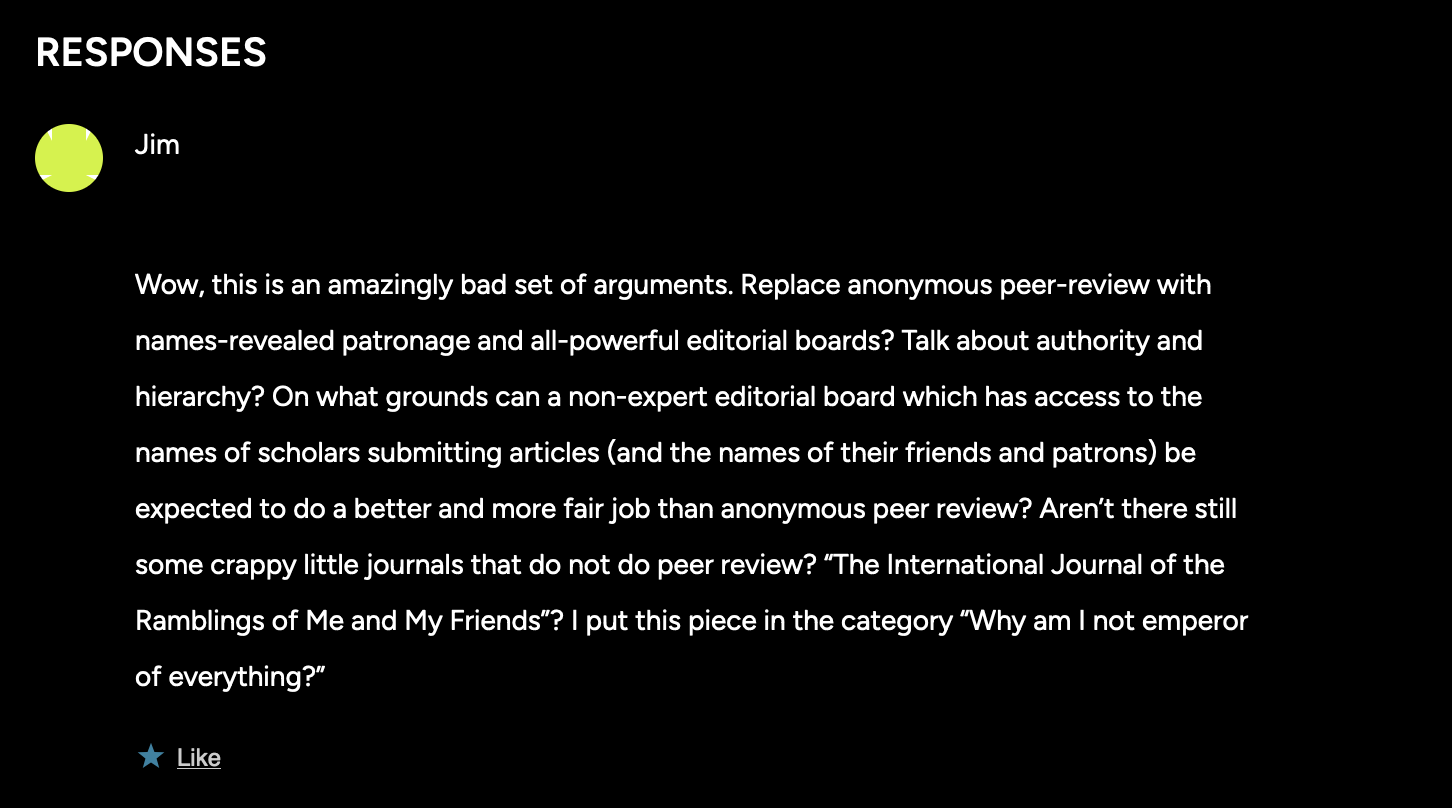
While reactive impressions have their time and place and should be assessed for their merits, it struck me then, as it does now, that many of those commenting on Bal’s manifesto simply missed her point. In my view, Bal is less interested in providing arguments for the destruction of peer review—an almost unthinkable proposition—than she is in reasonably concluding that system failure is the only remaining viable option.
Peer review is fundamental not just to academic publishing but to the entire context for producing knowledge in a university, whether in the sciences or the humanities. It also informs how universities are administered, from the process of hiring, tenure, and promotions to that of developing methods of teaching and building curricula. Historically, peer review has helped to counter the incursion of administrative methods adopted from the business world, where competing pathways of knowledge are both measured and validated on the basis of their relative exchange values. Bal writes, however, that by achieving the status of a “rule,” the peer-review system fails to deliver on its promises. More specifically, through a reflection on her long career, Bal observes that journal peer review is beholden to a neoliberal, rule-bound institution that awards hierarchy and behind-the-scenes authoritarian power, reduces inventiveness to a formalistic procedure, slows down an already burdensome administrative process, and disempowers junior scholars and editors alike. One can assume that peer review in university administration has met a similar fate.
Bal’s suggestions to recuperate from this unhealthy situation include providing support for editors to make editorial decisions and relying more on the journal’s editorial community for reviews. Neither of these alternatives need result in adopting unwieldly or undemocratic control over the editorial process or reducing rigorous scholarship to the “ramblings of me and my friends” (to quote Jim above). These alternatives rather expose the peer review system to a line of questioning about its methods and encourage scholars to evaluate lingering assumptions about what it means to be a reviewer. At the very least, they contain an invitation to think otherwise. The task of revisioning peer review was part of the inspiration for making this special issue. My co-editor Agata Mergler and I sought to develop an approach to peer review that was mindful to protect our editorial autonomy, allowing us to produce a coherent and meaningful issue (and—importantly for us and our junior contributors—to get the job done on time). Equally important, however, was our desire to encourage participation from our contributors through developing a multi-stage review of actual peers.
Our approach to peer review worked along two axes: 1) We conducted an anonymous review solicited by an expert in the field, consistent with the process identified by the journal; and 2) We conducted a collegial peer review, which involved pairing authors together and inviting them to comment on each other’s work. As a further step, after receiving their written comments, we scheduled a half-dozen (virtual) face-to-face meetings. In these meetings, moderated by Mergler and me, we encouraged authors to discuss each other’s work and offer helpful advice. We also encouraged more general conversation about each author’s creative work and how their written piece represents and/or complements it. After the meetings, we wrote decision letters based on the anonymous review, the author’s comments, the results of the conversations, and our editorial assessment of the entire process. On the face of it, this approach responds to Bal’s (2018) demand for “alternative possibilities to achieve what the system is meant but fails to achieve: quality control, or rather, quality stimulation.”
Our experiment in peer review did not seek to add “rigour” for its own sake. We also did not wish to “abolish” the peer review system, or even resuscitate it, and we did not claim to be heroic trailblazers in the wake of its demise. Our aim was merely to act as a facilitator for creative researchers, and to guarantee a space, however temporary, for an academic community that was not bound up in fragile notions of identity, creed, or mutual self-interest. On this basis, you could say that our desire was to make a space for dissensus. Though used and abused, Jacques Rancière’s (2010) concept of dissensus is instructive in this example because it is anchored in a constitutive separation of terms. In other words, by foregrounding how gaps in knowledge are expressed, the concept reveals a dynamic interplay of forces that could not be preceded or overshadowed by pre-existing actors, subjects, or concepts. More specifically, dissensus pushes back against normative ideas of community, which tend to feature prefabricated identities bound up in the pursuit of reputedly common goals and common sense.
“The partition of the sensible is the dividing-up of the world (de monde) and of people (du monde), the nemeïn upon which the nomoi of the community are founded. This partition should be understood in the double sense of the word: on the one hand, as that which separates and excludes; on the other, as that which allows participation.” (Rancière 2010, 36)
II.
Our concept for this project was framed by a question about something very abstract. It asked: are we now working (together) in a research-creation episteme? In other words, have we entered an epoch of “creative” research, requiring the retrofitting of university systems and evaluative practices to support this seemingly new platform for producing and disseminating knowledge? Have members of the university—at least those in the humanities—likewise shifted their emphasis away from knowledge and knowing as such? For Mergler and me, there was no template for these sorts of conversations, and certainly no direct or practical basis of support for how we raised them. There were no elaborate schools of thought to build on, no specific communities to flatter with citations, no methodologies, and approaches to uphold or contest. In fact, because the work we set out to do was premised on a question about something very abstract, there was no material reason to have these conversations at all. As such, we presupposed nothing except the fact that the question existed, that it has been circulating for some time, and that we, for better or worse, were among those who asked it. You could say that our effort to build a space for scholars to congregate at this juncture—around the question concerning the very existence of a community—was itself a kind of research-creation experiment. It arose from a desire to ask questions instead of receiving answers, and to seek conflict as opposed to combat. Speakers at our conference, hosted by Trent University on October 30th, 2023, and contributors to our journal issue each responded to this question, expressing inventive and often provocative pathways toward an answer.
If Mergler and I managed to achieve a “community” of scholars during this lengthy process, it would be one that is inoperative to any conditionality, rule, or objective. Often, for example, the responses we got derided the notion that research-creation should even be validated as scholarship. Looking to Jean-Luc Nancy (1991), we could say that the formation of community is never reducible to an absolute state of affairs. Assuming it could provide its own justification for existing—beyond any eventuality, and without any relation to the outside—such “community” would simply dissolve in adversity. The lesson here is that invariant ideas about the substance of communities are routinely vulnerable to interruptions, diversions, unexpected bridges or relationality, and existential threats of various kinds. The “idea” of a community is therefore inoperative in the sense that it remains perilously bound by a negative relation to adjacent terms. Nancy writes:
“Society was not built on the ruins of a community. It emerged from the disappearance or the conservation of something—tribes or empires—perhaps just as unrelated to what we call “community” as to what we call “society.” So that community, far from being what society has crushed or lost, is what happens to us—question, waiting, event, imperative—in the wake of society.” (11)
The method of peer review in operation at most journals in the humanities reflects a system dominated by senseless rules and broken promises just as Bal observes. However, such journals also reflect Nancy’s observations regarding the tenuous finitude that plagues communities in general. In our case, the completion of both the anonymous review of experts and the collegial review of actual peers straddled this inoperativity. It was peppered with mixed results, delays, and disappointments of various kinds. Limited by cold call-style e-mails, Mergler and I were challenged to find qualified reviewers who were willing to complete the thankless job. The sector’s stratified labour conditions were on full display among those who declined. While most established folks were unwilling to participate in the review process, many of those on the fringes were unable to. Examples to this effect appear below in a sequence that reflects the typical search for a single article. In this case, our top choice met us with a flat dismissal, followed by our second choice (a disclosure of research commitments), followed by our third choice (an expression of concern about the amount of work that a review involves), followed by our fourth choice (a statement of caution about the amount of knowledge expected in the research area). The pattern of declines featured here provides a snapshot of concerns surrounding the abject conditions of academic labour, with subtle indications about how specific groups of people might imagine their place in the system and how they benefit (or not):
Josh
Thanks for the ask/invite. Might have been good to include information and name of journal. I had to google this.
I’m not able to take this on.
Thanks
Sent from my iPhone
I’m afraid I just saw these emails – they all went to my junk folder, which I happened to just check today. Unfortunately, I’ll have to decline this request as I’m on research leave for the year.
I’m honoured you’d think of me for this opportunity! Though the essay sounds interesting, I’m afraid I cannot commit to anything right now given my current precarious work situation (working as self-employed translator with unpredictable workloads, and always looking for something more stable). With this in mind, I wouldn’t be able to dedicate enough time and energy to complete a peer review of great quality - sorry.
I am tentatively interested - I admittedly don’t have much experience in editorial or peer review processes, and haven’t been doing much academic work for a while, so I’m a bit out of the loop on current discourse, aside from loose familiarity with some of the implicit references in that abstract.
Bal’s piece addresses this worrying pattern. She highlights how it affects the quality of the reviews received, and particularly how it foists the burden of responsibility onto those who are precariously supported by the institution. Given how peer review is integral to the merit-driven governance of university systems, as mentioned above, the troubling conditions of unpaid, downloaded, and de-skilled labour is egregious, especially considering how easily these hierarchies are reinforced. At the end of the day, peer review is a deeply unfair system that is riven by inequities. In most cases, for everyone involved, it boils down to a question about the individual need for personal time, whether it be the ability to commit the time that is needed and the desire for self-preservation, weighing the obligation of time already claimed, or balancing between work and life, time, and energy. As Nancy writes, communities tend to develop through an antagonistic relation to death.
Adjacent concerns were raised during the collegial review. At this stage, Mergler and I had to constantly explain the process that was underway and the specific purpose for the meetings. The labour of repeating only further exposed how the peer review system (and its failures) have become so engrained in our scholarly practice. The system informs how we relate to each other on many different levels. In the case of one junior scholar, for instance, the mention of an additional review stage struck the ear as punitive, and at best, time consuming:
I am a little confused about the purpose of the meetup in the overall procedure of reviews – it seems that it is an added layer of revision to consider on top of blind peer reviews, so it feels like having to answer to 5 reviewers …
In an off-handed way, this defensive reaction is an obverse reflection of Bal’s (2018) comment that academic peer review is “fundamentally conservative,” in other words, that peer review validates a gatekeeping practice in which authors are cajoled into citing top authors, texts, and fields of study. Having five reviewers doing the gatekeeping instead of two might have been panic-inducing for this author. In these moments, Merger and I would be persuaded to further develop the concept of the meetings. Initially, because they were meant to be experimental and open-ended, it felt counter-productive to set an agenda. Gradually, however, after being repeatedly prompted to answer what are otherwise reasonable questions about the process, I discovered that this level of interacting was helpful for working through some of the contradictions of the existing system, and to focus on how the meetings could interrupt or reset the terms of review in general.
Senior scholars faced similar challenges. Indeed, for someone who has grown familiar with the double-blind peer review system—especially for those who have been on both ends of the process—the suggestion of an additional stage might have been confusing. In one specific case, it interfered with an author’s imagined role as a reviewer:
I have acted as an external and anonymous reviewer for a number of journals. Were I reviewing ■■■’s essay in that capacity I would, I’m afraid, reject it, without even the recommendation of a re-write for re-submission.
This reaction was fascinating to me because it condensed so many assumptions about the peer reviewer’s authority and responsibility into a single sentence—it is, quite by accident, a prime artifact of Reviewer #2’s storied legacy. After all, how could the task of the reviewer be otherwise than providing a scathing indictment of a contributor’s sloppy work? And how could this still be achieved in the context of a collegial—that is, non-anonymous—exchange? For the author, this unfortunate circumstance led to additional questions:
May I ask, do you have guidelines for how the first of the two reviews is to be, or could be, carried out?
How will the review process be made explicit or transparent to the reader of the journal?
Will the exchange between the writers be evidenced in publication, and if so how?
Have you considered the possibility that one of the contributors might reject the other’s work, and if you have what contingencies have you made?
For instance, would you publish one and not the other?
Is it the intention that the second review be carried out as a standard academic review, ie not “experimentally”?
While many of the answers to these were implied in the copy of instructions sent to authors and simply needed to be repeated, this line of questioning about the process is significant because it exposes the limits of the so-called “community” that could possibly emerge from the staged encounter of such meetings. Barring misunderstanding, avoidance, defensiveness, and outright refusal, Mergler and I set the bar extremely low. Although we had our own comments to make, and a general sense of how each meeting might unfold, we opened them with the briefest of instructions. We were adamant that this was a time for authors to get to know each other. And, in fact, some meetings had moments of levity and true connection. Others were deceptively rich in detail. And others were conducted more formally. For instance, one meeting had the vibe of a graduate seminar, prompting Mergler and I to act more as course instructors than as editors or facilitators.
To take stock of these different experiences, I refer to Monique Tschofen’s (2024) compelling piece in this issue about the alchemy of co-creation. Tschofen’s work instructs my own thinking on the subject. Notably, it strikes me that while everyone in academia willingly accepts the standard practices for publishing and peer review while being aware of its problems, many try to find surreptitious ways to overturn them—often to protect themselves from its most harmful outcomes. However, while these protective bubbles are intrinsically valuable, bring joy, and inform how to build a politics of resistance, they are also liable to pop.
This is how I view our experimental author meetings. Being supplementary to the standard practices, they were, as I mentioned above, totally unnecessary. They did not serve any other purpose than to engage discursively with another person’s work. None of the meetings were particularly conclusive. The difficulty of scheduling the meetings, sometimes with five academics across three time zones, was both maddening and absurd. On the other hand, I note that one meeting brought needed clarity to an author’s work in a way that would not have been properly communicated otherwise. Helpful instruction led an author to think differently about her subject in one, while a potential collaboration was formed in another. And in yet another, we witnessed a commiseration between future friends. To reflect on these meetings more speculatively, you could say that they provided hints about what sort of future peer review system could possibly replace the current one. Repeating Nancy’s (1991) basic argument, a community like this one must not be built without reference to the fate of death. By rejecting the tyranny of rules—and indeed the standard practices and systematic violence of academia—the authors who attended our meetings were constantly confronting them, identifying their limits, and participating in their decomposition.
III.
Consistent with dissensus, the aim of abolishing peer review is more reminiscent of decentring the logos or “living in the ruins,” as espoused by the postmodernists, than with overt destruction (Readings 1996). In other words, through the act of abolishment, we are tasked with fostering a sense of being-with that stems from a gap in the sensible as Rancière describes, and from a radical questioning of the agreed-upon terms by which spirited debates between actors or subjects can be held.
This gap is where I situate Tilottama Rajan’s (2001) commentary, “In the Wake of Cultural Studies: Globalization, Theory, and the University,” where she writes, “it’s important for us to remember that ‘university’ originally meant a group of people and not a place or institution” (77). Far from being a rallying cry for the nostalgic return to a bygone era when universities featured such a group of people as opposed to admins, I argue that Rajan’s observations provide us with a roadmap for the dissensus of institutional process. Imagine, for instance, a group of people congregating around an idea, problem, issue, or question, and how the participants in that group might harbour different and potentially conflicting perspectives, many of which will fall by the wayside. Then imagine this group adhering to a unified set of assumptions, practices, parameters, and evaluative logics, and consider the inevitable gaps that this structuring might introduce. By adopting a genealogical approach with respect to both the unifying terms described here and their points departure (and the potential for conflict that such departure implies), Rajan compares successive models of the university to determine how various situated ways of knowing—epistemes—inform and/or disrupt the process of learning and research.
In The Conflict of the Faculties, a model developed by Immanuel Kant during his censorship by Frederick William II circa 1798, the university is represented by a medieval distribution in which the various disciplinary branches are aligned with corresponding agents of social power, whether they be theology, medicine, or law (1992). Kant acknowledged that while this distribution rightfully continued into modernity, there was a growing need to introduce a “lower” faculty of critical philosophy to perform a structured interruption of the model. As Kant wrote in his essay, the lower faculty should be given the right to hold those in power to account for the rationality of their decisions or lack thereof. Though never realized, this model offers a groundwork for conferring legitimacy and institutional protection to the practices of “critique,” and it also bolsters the significance of the university when it comes to supporting social bonds. Undoubtedly, critical reflections, at least in the humanities, have shifted dramatically in the wake of “postcritique” (Felski 2015) and with the introduction of frameworks that seek to move away from the kind of upright and productive knowledge on which critique depends, as in evidence by the growing literature focused on “care” (see Tschofen, this issue).
While these debates are important for context, Rajan commits most of her article to the legacies (and presumed virtues) of the German research university at the height of philosophical Romanticism, an institution that was dominated by the likes of Fichte, Hegel, and the Schlegel brothers. For Rajan, the Romantic model of university knowledge returns to the distribution of the Enkyklos paideia, the “circle of learning” that is situated at the epicentre of a university consisting mainly of a group of people, not the bureaucratic model of a bricks-and-mortar institution (68). Returning to this moment to evaluate the contemporary situation is valuable because it shows us the possibility to imagine how learning can be achieved through a pedagogy of Bildung, which helps us to develop pathways of knowing that are shared between generations of scholars, and ultimately to articulate coextensive knowledge streams which are grounded by foundational disciplines, whether it be literature or philosophy or contemporary formations. This foundation not only brings a sense of coherence to the overall structure of the university as a culturally embedded institution, but it also lends a sense of purpose to the scholarly pursuit. It elevates critique as a modality of learning as opposed to the mere deployment of rationality, and it frames the activity of learning as the labour of a diverse but unified collectivity.
Rajan examines the Romantic university as a precursor of deconstructionism that flourished in the aftermath of WWII. Just as Hegel wrote about the onset of kenosis in the final pages of The Phenomenology of Spirit (1979), Rajan wants to focus our attention on the Romantic university’s adoption of “encyclopedic method” (2001, 69). By putting these two in alignment, Rajan reveals how disciplinary knowledge, as referenced above, is deeply interconnected, but also radically negative or unbounded. Bringing the Romantic thinkers into dialogue with Michel Foucault’s The Order of Things: An Archaeology of Human Sciences, published in 1966, which details the gradual deconstruction of the modern episteme, Rajan observes that in both approaches, knowledge is that which “unworks itself” through a dynamic process of rethinking both the foundational terms and diverse relationality of institutions like universities (80). Working from the premise of an uneven or disjunctive foundation that works against absolution at every turn, this model aligns with a practice of learning that supplements and thereby disrupts the functioning of the institution—a dissensus, in other words, that sharply contrasts with the Foucauldian characterization of modern-day “human sciences.” As Rajan writes, the mention of “human sciences” in The Order of Things refers to “the modern academy’s bridging of the humanities and social sciences under the form of a corporate merger, rather than an asystatic deployment of fields of knowledge to unsettle one another” (81).
Writing in 2001, Rajan’s major concern at the time was not about human sciences but about the troubling influence of “cultural studies”—its grotesque doppelganger. Rajan refers less to the peripheralized discipline that many may associate with the term today, than to the encyclopedic form of a dominant way of knowing, one whose stature resembles that of literature and philosophy during the Romantic period. According to Rajan, the rising tide of research with a “cultural focus” has developed into a core organizing principle of the university (67). Cultural research reflects an era defined by globalization, pejoratively depicted as the withering of cultural differences and political geography. Rajan goes on to claim that academic culturalism supports a homogenization of knowledge consistent with Western contemporaneity, featuring an impoverished vision of worldliness that is beholden to market forces, and communicated by a pluralizing rhetoric that treats instances of cultural specificity as mere exchange value. At best, this emergent practice of knowledge “exemplifies cultural study as the mimetic repetition of the technologization it studies” (Rajan 72). It reinforces a mutually beneficial relationship between the powerful actors that rule the social world, and the institution of the university with a mandate to produce its knowledge. It certainly does not achieve the kenotic—“self-emptying”—or “asystatic” deconstructionist impulse that (allegedly) lay at the core of universities in days from the past (81).
Rajan’s indictment is balanced by her desire to redirect the focal point of knowledge and its practices of learning and research back to the conditions of its own undoing, which is part and parcel of any deconstructionist labour. Through the immersion in a competing encyclopedic method that she labels “Theory,” Rajan situates culturalism as a parasitic form—a form that is endlessly attached to the precepts of theoretical inquiry, but which lacks the depth of understanding that it can bring to light.
Such an indictment can be found in other thinkers around this time. Notably, in Death of a Discipline, Gayatri Spivak presented a similar argument, suggesting that hegemonic Cultural Studies represented a generations-long invasion of the humanities by Western values and practices:
“Academic “Cultural Studies,” as a metropolitan phenomenon originating on the radical fringes of national language departments, opposes this with no more than metropolitan language-based presentist and personalist political convictions, often with visibly foregone conclusions that cannot match the implicit political cunning of Area Studies at their best; and earns itself a reputation for “lack of rigour” as well as for politicizing the Academy.” (2005, 8)
For Spivak, the preferred method of humanities scholarship originates from a capacity for deep language acquisition. Located at the intersection between Comparative Literature and Area Studies, Spivak maintains that the humanities could support a rigorous commitment to non-Western language training, and to radically exploding the Eurocentric focus of literature study in particular. By delving into literature learning as opposed to a cultural object or social practice, the humanities can gain a foothold on their promise to act as a gateway for knowledge about culture that is premised on the reader’s respect for idiomatic learning. In other words, Spivak maintains that knowledge centered on idiom is capable to reintroduce “the irreducible work of translation, not from language to language but from body to ethical semiosis, that incessant shuttle that is a ‘life’” (13).
IV.
For both Rajan and Spivak, there appears to be a strong desire to engage in modalities of learning and research that move beyond the quantified, identity-laden, overly politicized, and indeed “presentist” knowledge form that is most engaged with in Western humanities university departments (Spivak 2005, 8). These pursuits result in a congealed product that is too easily exchanged in the marketplace of ideas – and now, increasingly ridiculed and attacked by the right. In its place, we find efforts both to engage with the limits of our investment in values that lead down this path, and with an openness to radical alternatives, whether it be through language training as an enrichment of cultural knowledge, or through deconstruction of the episteme in the guise of Theory.
If we consider the many changes that have come about since the early 2000s, we can use these approaches to reflect on the conjuncture of the present moment. For instance, where does “research-creation” (the new buzzword for “cultural studies”) fit in all this? And what, after all, has “research-creation” become? Is it a rule? An episteme? What is at stake in such a project?
As this special journal issue demonstrates, there are no pre-set or definitive answers to these questions. Some of our contributors choose to explore these questions through co-creation (Tschofen) and through questions of intimacy (Foran and Xherro), through guerilla pedagogy (Rather) and theories of abduction (Madero and Carney), through questions of relationality (Dronsfield) and aesthetic experience (Arnold), through critical making as a modality of shared experiences (Sung) and play (van Vught and Werning), through writing (Principe) and de-writing (Mellet), and through celebrating non-human epistemes and the gaps contained therein (Tu, Confente). Given the sheer diversity of these offerings, it stands to reason that a major lesson of this special issue is that while there are many ways of knowing, there are an equal number of ways to untether or unwork what we know.
The other side of this equation is less promising. While the diversity of approaches from our contributors offers exquisite alternatives for research-creation, there are always countervailing forces at play. In recent years, we’ve heard louder calls for a working definition of the practices surrounding research-creation. These concerted efforts will inevitably result in new mechanisms to quantify, evaluate, and award – key ingredients for the recognition of academic work. For now, the criteria seem rather permissive. For instance, the Social Sciences and Humanities Research Council (SSHRC) definition can include many different varieties of practice-based approaches under the auspices of meritorious research, and in fact, it represents a significant expansion of the latter. On the other hand, more suspiciously, SSHRC’s permissive guidelines can be understood as a concealed initial effort to gather and mine information, which is pertinent if you consider the uncertainly of defining this practice in the context of university-level research. As the patterns of academic labour will show, the institution rarely squanders an opportunity to benefit from the work of others. Given that, how long will this permissive stage last? When does permissiveness return in the form of a prerequisite, restriction, or denial?
In the department where I teach, questions about research-creation are at the forefront of both our imagined future (as applied concretely in our approach to student recruitment and retention), and the many opinions and viewpoints that unite and separate us as colleagues. So far, our approach has settled on collectively interrogating the art object, and specifically on whether the object can be deemed “exhibitable” by an outside individual or group. In many ways, this follows the criteria of writing a dissertation in our PhD program, namely that the result be evaluated for “publishable quality,” and that the finished work meets this benchmark by an independent examiner. Both criteria are problematic for reasons that are beyond the scope of this paper. What I want to draw attention to here is that these evaluative models betray an obsession with the product, as if the product’s ability to behave as an exportable commodity is an indicator of value. On a deeper level, obsessing over the product and over productivity in general is anchored in a Western colonial mentality that brackets definitions of knowledge and research by the author’s capacity for originality, discoverability, and ownership. At the very least, this runs counter to how we teach graduate students to conduct their research.
One of the pressing issues that tends to arise in these debates is not only a fixation on the products of research, but on questions about art as such, whether it be the art object, the process of artmaking, curatorial practices, or aesthetic experience. To be sure, these debates are important to advancing research-creation as a viable pursuit, and they have undoubtedly captured the attention of many contributors of this special issue. Incorporating artistic practice into academic contexts is both crucial and ongoing. On the other hand, the focus on art, and on the diversity of its products often have limited benefits, especially when it comes to justifying artistic practice as research in the classroom. At worst, the institutional pattern of connecting art practices through a growing fixation upon objects of quality leads to an unseemly pedagogy, often resulting in cult-like teaching styles that award students of quality and disregards the rest. It should come as no surprise that such dynamics trend bad.
Gerard Vilar (2018) offers five compelling alternatives for the consummate creative researcher. Most notably, by framing the artist as a social researcher, Vilar shows how the practiced dimension of the resulting “work” can break from the demand to produce an object of quality. In this alternative, the work becomes a means to an end and a tool to answer research questions. Certainly, technical skills may be needed for the completion of research, and the product itself may follow conventions of the practices associated with those skills, such as in the case of making a documentary film. But under no circumstances must the work congeal into an object and be assessed for its qualities. Correspondingly, the curatorial researcher is ensconced in the practice of arranging objects in time and space, often in such a way as to support an argument. The artist as a challenger of norms is conceived as an individual who detourns the social order through playful deconstruction. The artist conceived as an explorer of the great beyond looks outside the social fold to speculate about an unwritten future. In all these alternatives, the outlier appears to be the artist as a producer of objects, which is where I situate most of the current discourse.
Vilar ends his short article with a meditation on the challenge of thinking versus knowing:
“Thinking is much larger than what is known. Art, religion, philosophy and science are forms of thinking about the world, ways of trying to make sense of it, to establish meaning. But thinking and knowing do not necessarily coincide.” (9)
Consistent with Vilar’s observation, I argue that research-creation can provide a framework for thinking beyond knowing, for communicating in ways that don’t easily settle into forms of productive knowledge. As Vilar observes, such a practice of thinking and working-through can be provocative or disruptive, especially if you consider everything that is collectively known. Whereas knowledge is situated firmly in reality, thinking sits adjacent to it as a constant exchange between truth and falsehood. Vilar quotes Picasso, who said, “art is a lie that makes us realize truth, at least the truth that is given to us to understand” (8). In other words, art—assuming we have resigned ourselves to this limitation—is not reducible to an object of knowledge but is rather akin to a process that generates an act of thinking or working-through. Thinking is separate from knowing insofar as it creates pathways toward truth—not a spherical or shiny object to be sold in the marketplace of ideas, but a thorny, knotted reality.
Vilar’s meditation informs my suggestion that we abolish so-called “research-creation.” At best, research-creation cleaves toward the possibility of exploiting the gap in our standards of evaluating scholarship. Research-creation is strongest when it makes a place for critical practices that did not exist before it was articulated as a possibility to advance knowledge in general. To cull a phrase from Rajan, research-creation must achieve the status of being a practice that “unworks itself” (80).
In calling for the abolishment of research-creation, I am not advocating for its outright destruction. Nor is my aim to destroy the potential to yield livable results through them or to lose the ability to instrumentalize their perceived value for those who struggle to gain a foothold in the university. Abolishing the institutionalized terminology surrounding the work to which it is associated does not mean abolishing the work. After all, research-creation is research. My aim in this afterword and in the special issue is not caught up in these quagmires. Rather, my aim has been to shift research toward creating a pathway for collegial peer review in ways that are consistent with Bal’s counterproposal. Together with my co-editor Agata Mergler, our aim was to establish a community of scholars that does not rely on precarious tendrils of a conventional or pre-established social bond, whether it be in the name of identity, creed, or self-interest. Our research-creation experiment has aimed rather at developing a community of those with nothing in common, and to create a space for ideas that has no basis or even will to persevere beyond its use value.
If research-creation becomes standardized into a rule and cajoled into upholding markers of quality, then the cause for it has already been lost. In that case we should, by way of its abolishment, find ways to protect ourselves from its reach.
Works Cited
Bal, Mieke. “Let’s Abolish the Peer-Review System.” Media Theory blog edition (2018), https://mediatheoryjournal.org/2018/09/03/mieke-bal-lets-abolish-the-peer-review-system/.
Felski, Rita. The Limits of Critique. The University of Chicago Press, 2015.
Foucault, Michel. The Order of Things: An Archeology of Human Sciences. Routledge, 2001.
Hegel, G.W.F. The Phenomenology of Spirit. Translated by A. V. Miller, Oxford University Press, 1979.
Kant, Immanuel. The Conflict of the Faculties. Translated by Mary J. Gregor, University of Nebraska Press, 1992.
Nancy, Jean-Luc. The Inoperative Community. TransLated by Peter Connor, Lisa Garbus, Michael Holland, and Simona Sawhney, University of Minnesota Press, 1991.
Rajan, Tilottama. “In the Wake of Cultural Studies: Globalization, Theory, and the University.” Diacritics, Vol. 31, No. 3, Theory, Globalization, Cultural Studies, and the Remains of the University (Autumn, 2001), pp. 67-88.
Rancière, Jacques. Dissensus: On Politics and Aesthetics. Translated by Steven Concoran, Continuum, 2010.
Readings, Bill. The University in Ruins. Harvard University Press, 1996.
Spivak, Gayatri. Death of a Discipline. Columbia University Press, 2005.
Vilar, Gerard. “Does Artistic Research Produce Knowledge? A Fivefold Distinction.” Estudis Escènics, No. 43 (2018), pp. 1-9.
Image Notes
Figure 1: Comments on Mieke Bal’s blog entry in Media Theory.